PhD research · UC Berkeley EECS

Applied Estimation of
Mobile Environments

My Ph.D. dissertation, Applied Estimation of Mobile Environments (UC Berkeley EECS, 2014), is about a problem that turned out to define the next decade of my career: how do you actually estimate what's happening in a messy, moving, real-world environment — when the sensors are noisy, the hardware budget is tiny, the robot can barely steer, and a wrong answer has consequences? It spans field robotics on the Sacramento–San Joaquin Delta and a building full of low-power sensors watching people move. Here are the highlights, in plain language, and where each one led.

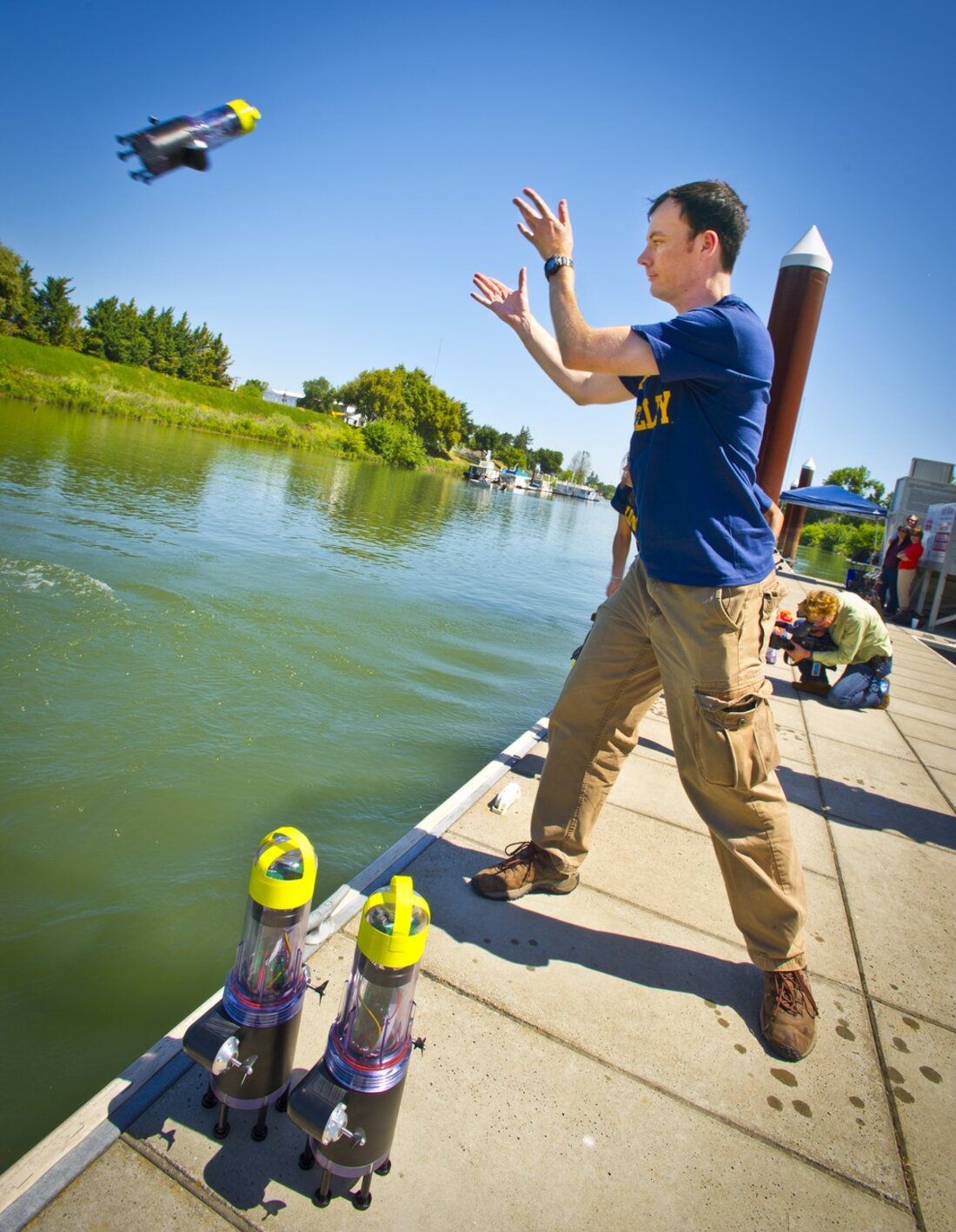
Researcher on a dock launching a self-propelled river drifter robot into the Sacramento–San Joaquin Delta, with low-cost Android-phone drifters in the foreground.
Launching a Generation-3 active drifter during a Delta field campaign; low-cost Android-phone drifters in the foreground. Floating Sensor Network, UC Berkeley.

→ Builds, ships & leads · embodied sensing

A fleet of robots that ride the river

To measure how water actually moves through the Sacramento–San Joaquin Delta, our lab built drifting robots — including a low-cost one built around an Android phone (cheap enough to deploy in dense swarms) and a self-propelled "Generation-3" drifter. I designed the electronics and on-board software (verified in software-in-the-loop simulation before it ever touched water) and helped assemble roughly 140 of them. The data those swarms returned was assimilated into reconstructed flow fields of the river.

Today: The instinct hasn't changed: get a lot of cheap, rugged, autonomous things into the field and make the data they bring back actually usable. That's the autonomous material-handling vehicle, the XPRIZE wildfire drones, and 20-plus Think Circuits builds.

  • Heterogeneous Fleets of Active and Passive Floating Sensors for River Studies
    Journal of Field Robotics 33(5), 2015
  • Applied Estimation of Mobile Environments — Ch. 2, Mobile Floating Sensors
    Ph.D. dissertation, UC Berkeley, 2014
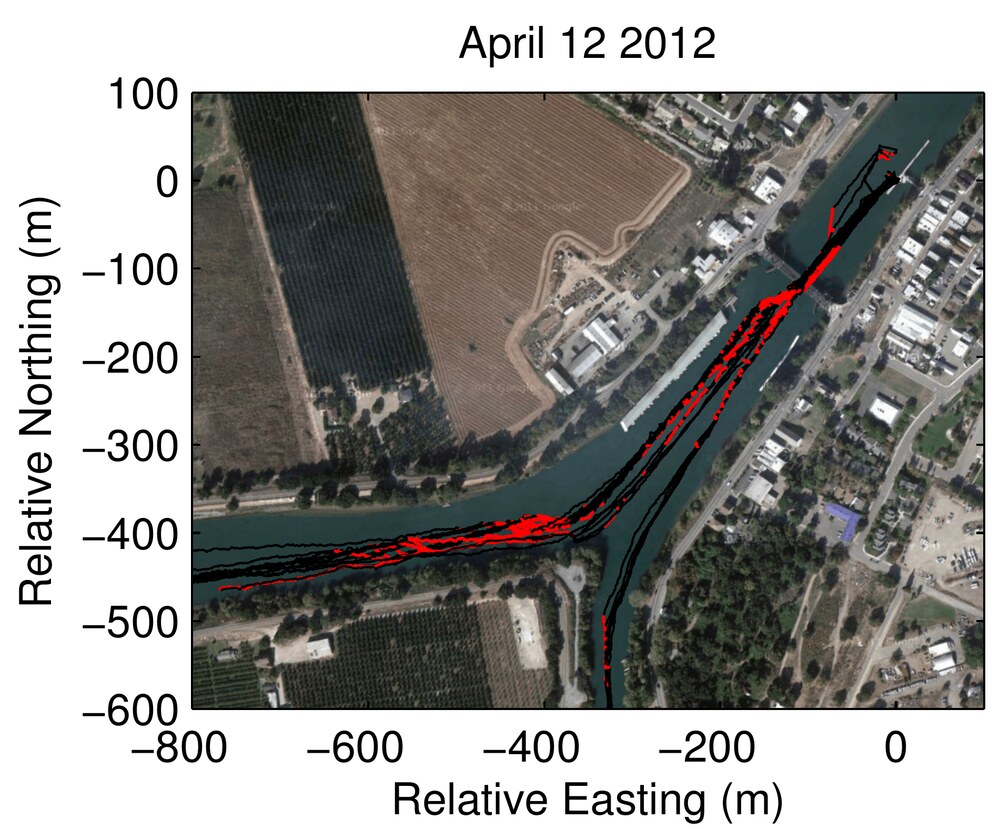
Satellite view of a river reach with the GPS track of an active drifter overlaid, showing it staying in the channel and away from the banks.
Field test, April 2012: an active drifter (red track) holding the channel and steering clear of the banks where passive drifters got stuck. From the IEEE Transactions on Robotics paper, 2014.

→ Safety-critical by construction

Robots that can't be told "turn around" — but stay safe anyway

A drifter has almost no control authority — mostly it goes where the current takes it. I built a controller using Hamilton–Jacobi reachability: it computes ahead of time the set of states from which the robot can still avoid running aground, and nudges the drifter just enough to stay inside that safe set. Multiple field tests on the river confirmed the active drifters avoided getting pinned on the banks where ordinary passive drifters got trapped.

Today: This is the direct ancestor of the confinement-safety logic in the iRobot Terra robotic mower, and of my patent portfolio on safety-critical DSLs, WCET analysis, and hybrid safety verification — the "can this learned system actually be allowed to act?" question.

  • Autonomous River Navigation using the Hamilton–Jacobi Framework for Underactuated Vehicles
    IEEE Transactions on Robotics, 2014 (preliminary version: IEEE ICRA, 2011)
  • Applied Estimation of Mobile Environments — Ch. 3, Hamilton–Jacobi Safety Control for Underactuated Sensors
    Ph.D. dissertation, UC Berkeley, 2014
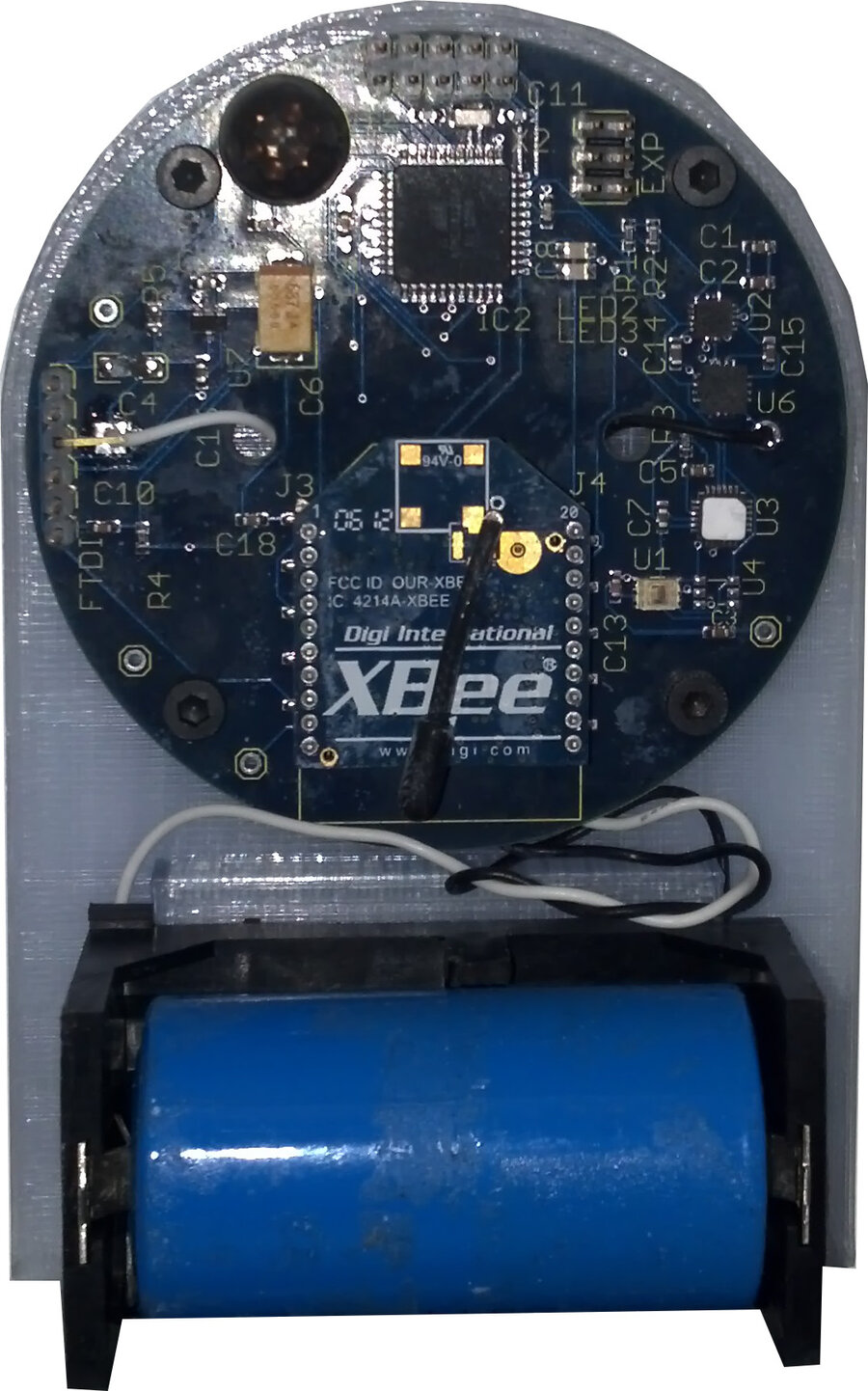
Open battery-powered indoor environmental sensor board with a WiFi radio module and a single 18650 lithium cell.
The battery-powered indoor environmental sensor — WiFi radio, passive-infrared, temperature, humidity, light and acceleration — running on a single lithium cell. Later productized as "Building-in-Briefcase."

→ ML that fits on the device · edge

A sensor that runs for five years on one battery

To study how people move through a building, I designed a small battery-powered sensor — passive-infrared, temperature, humidity, light level, acceleration, streamed over WiFi — plus the communication architecture to collect it all into one repository, plus plug-in expansion boards (CO₂, particulate matter, RFID badge-in, door contacts). Measured current draw showed it could run more than five years on a single battery. The design later became the "Building-in-Briefcase" rapidly-deployable sensor suite.

Today: Squeezing real capability into a hard power / latency / memory budget is the whole job: shipping an audio-enhancement model to the Qualcomm Hexagon DSP, nRF52 / STM32 firmware with bootloader and OTA, next-gen Fitbit wrist algorithms, and AWS-IoT fleets at 50,000 devices.

  • Building-in-Briefcase: A Rapidly-Deployable Environmental Sensor Suite for the Smart Building
    MDPI Sensors, 2018
  • Applied Estimation of Mobile Environments — Ch. 4, Indoor Environmental Sensors for Mobile Sensing
    Ph.D. dissertation, UC Berkeley, 2014
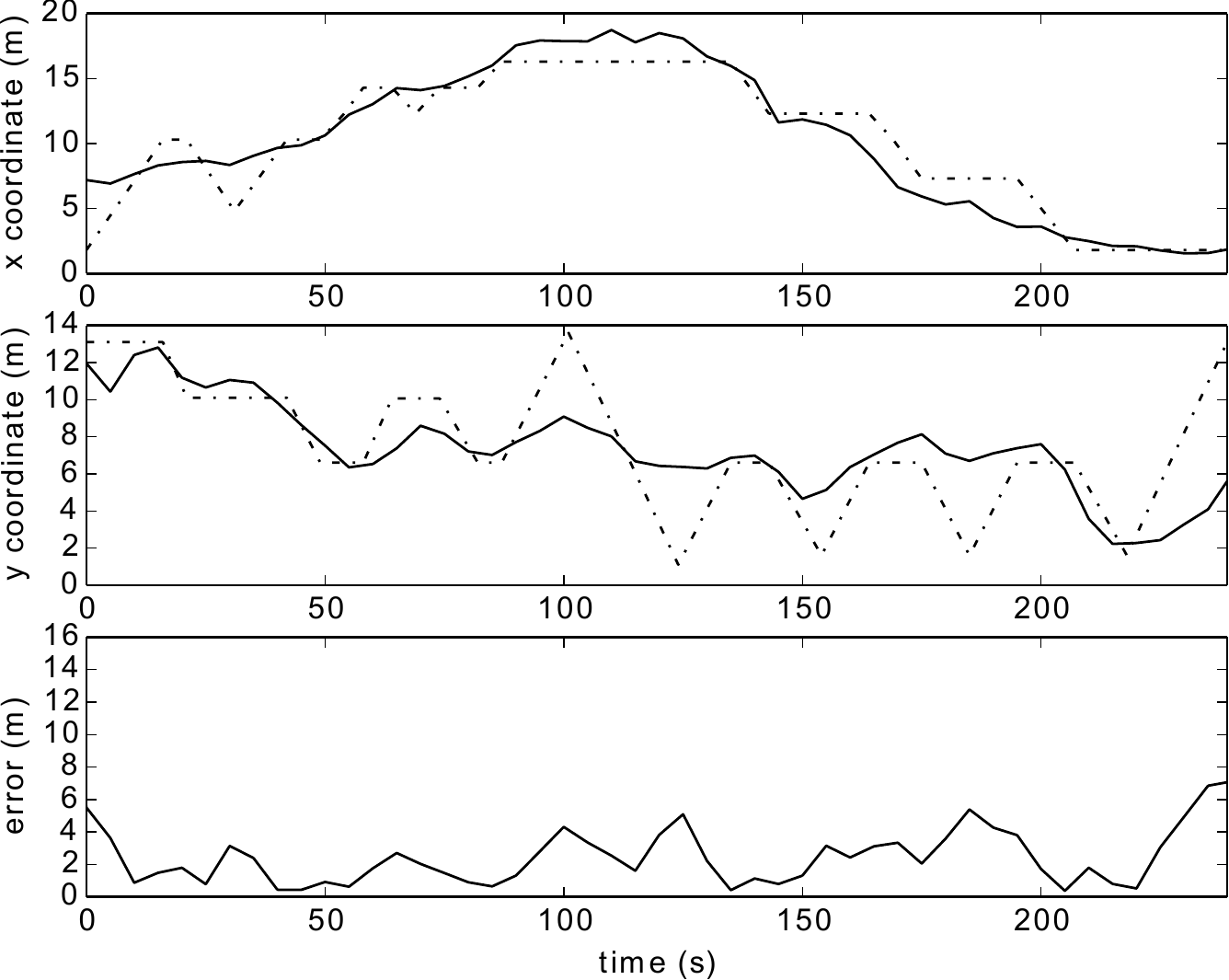
Plots of estimated x and y position over time against ground truth, plus position error staying within a few metres.
Particle-filter position estimate (solid) vs. ground-truth walk (dashed), with error mostly under a few metres. Indoor RSSI testbed, dissertation Ch. 6.

→ Embodied AI · sensor fusion (particle filters)

Tracking a person indoors from nothing but radio noise

In a testbed in Singapore, 24 sensors in the ceiling measured the signal strength of a one-second beacon from a battery-powered tag. I built a sequential-importance-resampling particle filter to turn those noisy RSSI readings into a position estimate: a statistical RSSI-versus-distance observation model fit from a slow ground-truth walk, and a transition model that respects walls and limits motion to a plausible walking radius between updates. In validation runs it tracked the tag to within a few metres.

Today: This is where the multi-sensor SLAM and long-horizon localization work at OMRON and iRobot comes from, along with perception on Embark's autonomous-trucking stack and the particle / Kalman filtering in Think Circuits products.

  • Applied Estimation of Mobile Environments — Ch. 6, Filtering Algorithms for Occupant Tracking
    Ph.D. dissertation, UC Berkeley, 2014
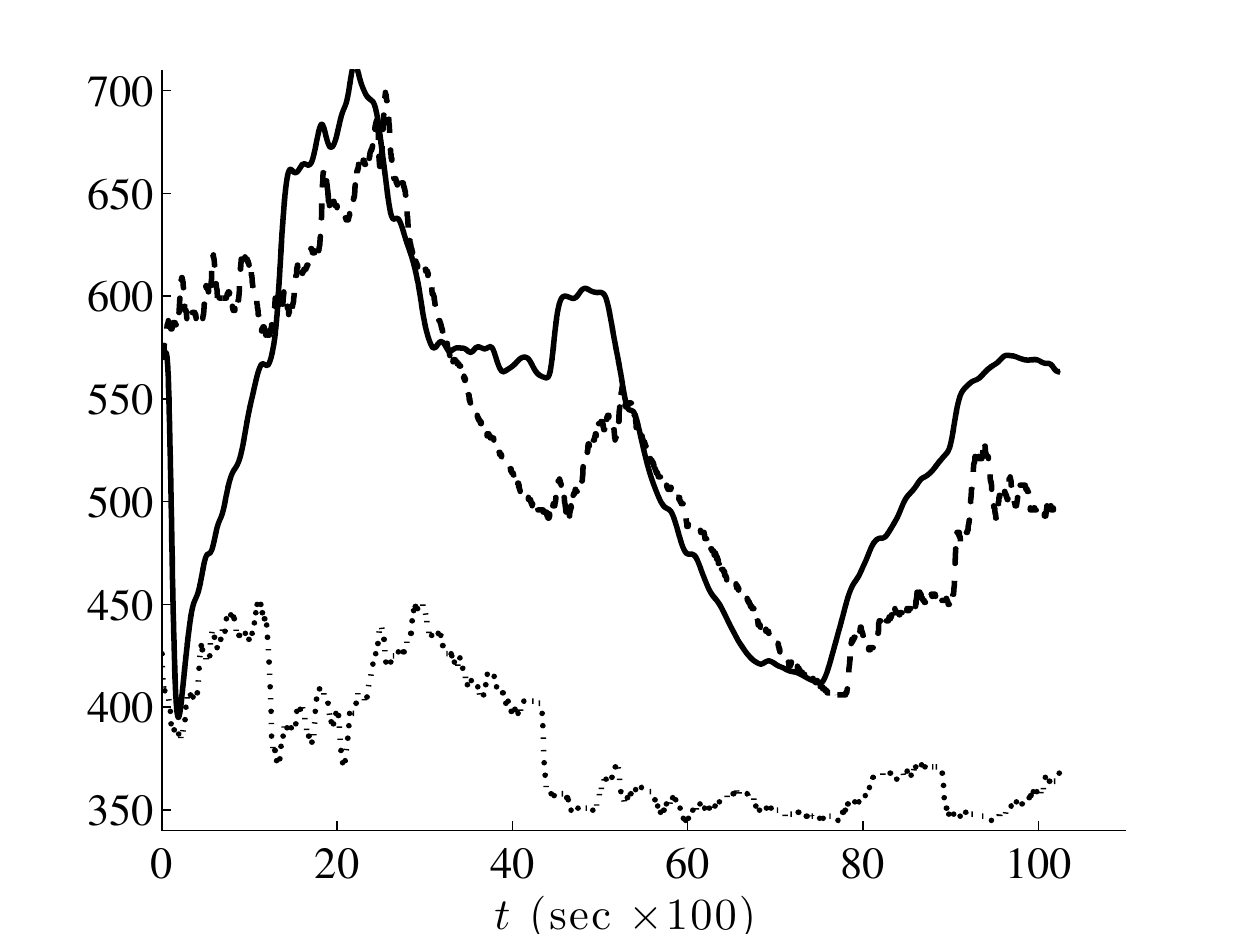
Plots of measured CO₂ concentration in a conference room against a fitted dynamical model and the estimated occupant-generated component.
Conference-room CO₂: measurement vs. fitted ODE/PDE model vs. estimated occupant-generated component. From the IEEE Transactions on Control Systems Technology paper, 2015.

→ Model-based estimation · system ID · rigor

How many people are in this room? Ask the CO₂.

A separate study, and a deliberately rigorous one: release a known amount of CO₂ into a conference room, watch it with about 15 sensors, and fit the room as an ODE / PDE; then run the model forward — given the measured CO₂ curve, estimate how much was generated by occupants, and from that, how many people are present — with the model parameters identified online so it adapts to a real, drifty room. First-principles dynamical-systems modelling, system identification, and observer design, end to end.

Today: The same model-in-the-loop estimation discipline shows up in the PDE thermal model and Kalman instant-read estimator inside a shipped cooking appliance — and in how I reason about whether an estimator can be trusted to drive a decision at all.

  • Modeling & Estimation of Humans' Effect on CO₂ Dynamics Inside a Conference Room
    IEEE Transactions on Control Systems Technology, 2015
  • Occupancy Detection via Environmental Sensing
    IEEE Transactions on Automation Science and Engineering, 2016
  • Applied Estimation of Mobile Environments — Ch. 5, Models of Indoor Occupancy
    Ph.D. dissertation, UC Berkeley, 2014

Dissertation committee: Alexandre M. Bayen (chair), Kristofer S. J. Pister, Costas J. Spanos, and Steven D. Glaser. The full dissertation, conference papers (ICRA, CASE, DCoSS, ICNP, UbiComp), and complete publication list are available on request — get in touch.